Chapter 0 · Prologue
The Awakening in the Mists
The sky over Spira had never hung so heavy. Dark clouds coiled above the cliffs, as if the world were holding its breath. The air was thick with salt, with secrets, with forgotten memories.
In the depths of the Nacre Archive, a man was running.
His tattered coat streamed behind him; his boots scraped the thousand-year dust of a floor carved by vanished hands. In the guttering light of his lantern, the walls seemed to tremble. Ancient glyphs glowed faintly upon them — and went out one by one as he passed, like eyes giving up.
Not broken. Erased.
A roar tore through the silence. He turned.
A beast. Unnameable. Made of shadow, of flesh, of hate — and wherever it set its paws, the stone forgot even the shape it had been given.
The man stopped running. There was no stairway left behind him, only the great hall of the seal, and the spiral groove carved into the centre of the floor. He stood straight. Sword in hand. He had not fled this far to die on his knees.
From his neck he tore a medallion of nacre. With one sharp blow against the stone he broke it in two — and drove one half into the groove of the seal. The other, he clenched in his fist.
— If anyone reads this… he murmured. Tell him I love him.
A flash. An explosion of light.
Then the dark.
A cry. Breathless. A name strangled in the throat.
Sael sat up in his bed, drenched in sweat, his heart pounding like a festival drum. Outside, the sun was barely rising over the isle of Anchorage. Through the window, the sea shone, peaceful — the exact opposite of the storm he crossed every night.
The same dream. Always the same: the sanctuary, the beast, the light. And the man's voice, murmuring something at the very end — a sentence Sael never heard in full, because the dream always tore itself apart on the last words. Since childhood, he had been told that nightmares fade as you grow. But on Anchorage, some dreams are not dreams. They are memories the world refuses to let go — memories looking for a head to live in.
His mother came into the room.
— That dream again? Talia asked softly, sitting down on the edge of the bed.
He nodded without a word.
She laid a hand on his shoulder.
— It's your day, today. You know what your father would have said?
He raised his eyes to her. She smiled sadly.
— He would have told you not to lose your fire.
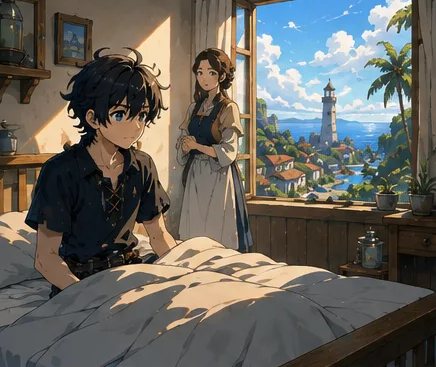
Port-Lantern was waking slowly. Merchants were setting up their stalls, children ran along the quays, and the elders gathered around the well, under the steady gaze of the Beacon — the lighthouse-lantern that is never allowed to go out. Everything seemed normal.
Too normal, Sael thought, without knowing why.
He went down to the Dry-Dock, the forge built inside an upturned ship's hull, where his grandfather was already hammering steel.
— You planning to stand there watching me, said Bram Seven-Hammers without looking up, or do you want to learn to handle something other than your tongue?
Sael smiled. It was the same ritual every morning. The old blacksmith never spoke of his son — Sael's father — but he kept his journeyman's hammer hung above the anvil, oiled, immaculate, like a word one never manages to say.
His grandmother was waiting for him in the garden of the apothecary, surrounded by phials and strange plants. Sillane handed him a flask.
— For the nightmares. And for the mornings after festivals.
Because tonight was the full moon. The Festival of Lanterns.
And his sixteenth birthday.
By nightfall, the village square had transformed. Garlands, drums, ancient songs — or what remained of them: people hummed more than they sang, for the words were lost a little more each year, and nobody seemed to worry about it. Everyone was there. Maëla Shellbreaker, the village head, handed out the paper lanterns one by one, and each person wrote a name on theirs — the name of someone gone, so that the sea would remember in our place. Even old Corvo the Reader, a stooped silhouette with a gnarled cane, had come down from his altar; his pale eyes never left Sael.
Sael wrote his father's name in a careful hand: Aurel.
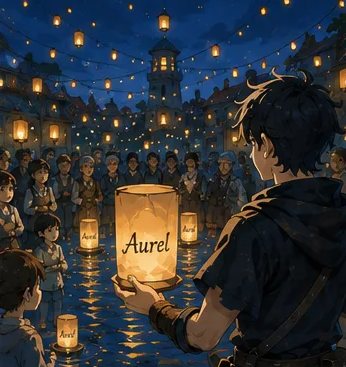
A hundred lanterns went down to the black water. A hundred lights caught the evening current, drifting gently out to sea, together, like a school of docile fish.
All but one.
Sael's lantern turned slowly on itself — then went back up the current. Alone, stubborn, it slid against the tide, straight toward the black islet you could glimpse offshore on mistless evenings. The one whose name the old folk never spoke.
That was when his mother approached. In her hands, a box of polished wood. And in the box, on a bed of cloth — half of a nacre medallion, broken across.
— It belonged to him, she said. The sea gave it back to us with him, clenched in his fist. I open this box every year, on the morning of your birthday. It has never glowed. Until this morning.
He took it. At the touch of his skin, a soft light rose from it, the same quiet white as the moon on water. His heart tightened. He understood.
Something was awakening.
Much later, as the festival died out fire by fire, someone shouted from the jetty. Far away, on the black water, Aurel's lantern had just touched the islet.
It went out.
In the night, led by a silent impulse, Sael climbed to the attic. Under sheets, crates, stacked-up memories, his hands found what they had been looking for without his knowing: an old journal. Bound in leather. Marked with the same symbol as the medallion — a spiral.
Inside: unfinished maps. Sketches of creatures, annotated in a cramped hand — his father's. Formulas, tide readings. Page after page of a Cartographer's life… then nothing. The entire second half of the journal was blank, like a sentence cut off in the middle of a word.
On the very last written page, a single sentence, copied line after line, pressed harder and harder, until the pen tore through the paper:
The awakening begins when fear dies.
The awakening begins when fear dies.
The awakening begins when fear dies.
Sael closed the journal, short of breath. That was when he saw it: on the leather of the cover, the engraved spiral was not just a drawing. At its centre, a hollow — the exact size and shape of his half of the medallion.
He laid it there. It clicked into place like a piece that had never been lost.
The journal opened by itself. The pages turned without wind, went past Aurel's last line, and stopped on the first blank page — blank for sixteen years. Then, before his eyes, ink rose up out of the paper the way blood rises from a cut. Fine, slanted letters. Not his father's cramped hand. Nobody's hand — as if the page itself were choosing the shape of its words:
The tide remembers.
Come and read.
It was that night that Sael truly heard it for the first time — by hearing it stop.
For as long as anyone could remember, there had been a heartbeat under the island. A deep, slow, regular sound, rising from beneath the sea, so old and so constant that nobody on Anchorage heard it anymore — the way you do not hear your own heart. The old folk called it the surf.
It was not the surf.
That night, for the first time in living memory, the heartbeat
stopped.
The next morning, before the village woke, Sael left Port-Lantern. The Journal in his satchel. The medallion at his neck. His eyes fixed on the island's interior.
On the cliff path, a small bell chimed.
He spun around. On a collapsed arch, three steps away, a fox was sitting — or rather, something that had decided to look like a fox. Its coat was made of sea-foam, white and shifting, shot through with turquoise glints, and at its neck hung a small glass bell that chimed in rhythm with the waves.
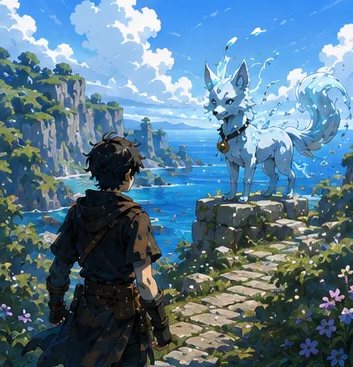
— You smell of ink, she said. Her voice was exactly the sound of the surf inside an empty shell. Like the other two.
Sael did not ask who the other two were.
Not yet.
He tightened the strap of his satchel, and walked.
Toward the ruins.
Toward the truth.
Chapter I
The Cliff Path
The forge was already warm when Sael passed the Dry-Dock, in the blue before dawn.
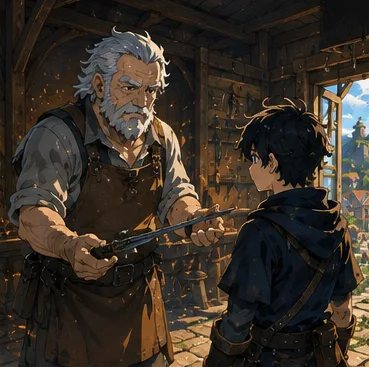
Bram was waiting on the threshold. Standing, arms crossed, as if he had been keeping watch for hours — and perhaps for years. The old blacksmith said nothing. He did not ask where his grandson was going with his full satchel and his shadowed eyes. He simply held out his hand.
In his palm, a slender object, half dagger, half quill, in a sheath of soft leather worn down to the weave. Aurel's sounding stylus. The tool every Cartographer carried at their side — not to fight, but to read: to follow the glyphs, to sound the stone, to wake what sleeps in the old marks.
— It's not a weapon, said Bram. His son used it to ask questions.
He closed Sael's fingers over the sheath.
— Ask the right ones.
It was the longest sentence he had ever spoken about his son. He went back into the forge without waiting for an answer, and the song of the hammer resumed, steady, like a heart starting up again.
Talia was waiting at the edge of the village, where the flagstones of the road give way to bare earth. She was not crying. She slipped into his satchel a loaf still warm, and Sillane's flask — for the nightmares, and the mornings after festivals.
— I won't tell you not to go, she said. I married a man who was told that all his life.
She rested her forehead against his, for one second.
— Don't lose your fire.
The cliff path climbed in switchbacks above the bay, cut into the pale rock, edged with tall grass that the sea wind combed all in the same direction. Below, the sea lay flat. Too flat. Since the heartbeat had gone silent, the water seemed to be holding something back — like a sentence no one dares to finish.
The glass bell chimed somewhere above him.
Seafoam went from arch to arch, effortlessly, her foam coat undone and remade with every leap. She was not walking with him, not exactly. She went where he went, that was all, the way foam follows the wave.
— You hold your inkwell tight, she observed from a rock, her voice full of seashells. Is it the journal in your satchel that weighs so heavy? Or what it has not yet written?
Sael did not answer. He was beginning to understand that the fox never asked questions to get answers.
Halfway up, the path widened around a squat ruin: an old tide-watch post, from the days when the Cartographers logged every breath of the sea. A caved-in roof, every other wall, and that smell of trapped salt that stones have when they have listened to the water too long.
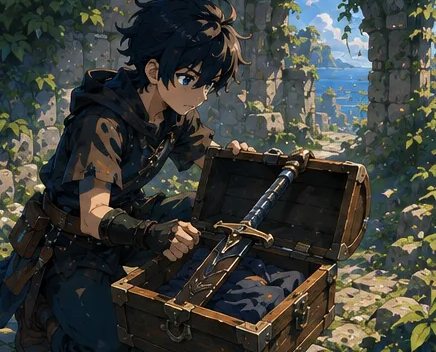
Inside, under an overturned stone table, a wooden chest swollen with salt. The lid gave way on the second try.
Within, rolled in oilcloth: a short sword. Its edge worn, its guard pitted with verdigris, the leather of its grip polished by a hand that was no longer there. Not a hero's weapon. A weapon that had served — that was all you could say of it, and it was already a great deal.
Sael lifted it. It was heavier than in the dreams, and more real.
— It has bitten before, Seafoam commented, sitting in the frame of the dead window. Blades are like tides. They remember. It will remember for you, the first few times.
The first few times came a hundred paces further on.
The island's heartbeat had gone silent, but something else had started moving in its place. In the hollows of the path, the puddles left by the last rain no longer reflected the sky. They watched it.
The first puddling rose from its puddle like a drop falling in reverse — a ball of murky water, knee-high, shot through with drifting grains of sand, with two dark points at its centre that stood in for a gaze. Water that had decided to be hungry.
Sael took a step back. It leapt.
It was not a beautiful fight. He struck too early, too hard, cut mostly air and a little rock. The puddling splashed against him with all its weight, ice-cold, and he felt it pulling — that this water wanted to drink something that was not water. The second one was already rising from its puddle.
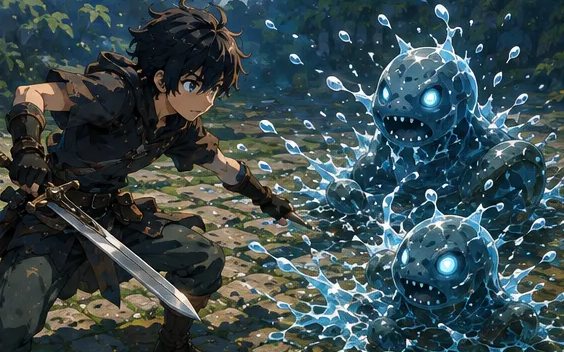
So he stopped striking the way they do in stories, and struck the way they do at the forge: short, aligned, at the moment it opens. The worn blade went through the first puddling from side to side. It fell back as ordinary rain, with the sigh of a wave withdrawing. The second one hesitated — if water can hesitate — then lay back down in its puddle, became a reflection of sky again, and did not move from it.
Sael stayed bent double for a long moment, trembling hands on his knees, his heart in his ears.
— I was afraid, he breathed. The whole time.
— Good, said Seafoam. Fear is what dies last.
He looked up. The bell chimed, in a way that might have been a laugh.
— The awakening begins when fear dies, he recited. It's written a hundred times in my father's journal.
— Then you are not awakened yet, said the fox, taking to the path again. Good. Those who awaken too fast drown.
The Stele was waiting at the summit, where the path stopped climbing because there was nothing left above it but sky.
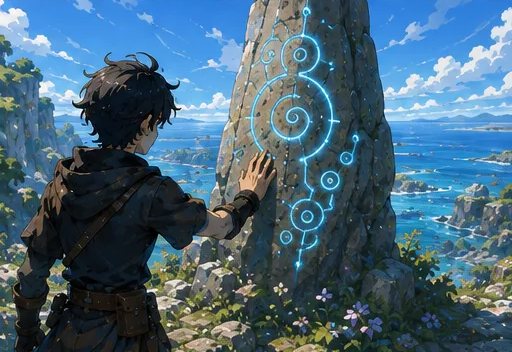
A needle of grey stone, twice the height of a man, planted in a circle of grass-eaten flagstones. Across its whole surface ran a spiral engraving — and along the spiral, dozens of round nodes, like pearls on a thread, each marked with a tiny glyph. Centuries of wind had polished it without erasing a single mark.
The medallion began to warm against Sael's chest before he had even reached the circle.
He did what his father did in the journal, in the sketches: he drew the stylus, and he read. The fine point found the first glyph, at the centre of the spiral, and followed it the way you follow a line with your finger.
The glyph lit up.
A nacre light, quiet, rose from the heart of the stone — and the first node of the spiral began to glow like his lantern on the black water. Then the light ran along the thread, brushing the next nodes without lighting them, just enough to show them: dozens of paths, forking, crossing, meeting again further on.
And Sael understood, though no voice spoke, what the Stele was showing him. Not a destiny. Not a traced-out road, like in the stories where you are born a smith, a soldier or a mage.
All the roads. The thread was waiting for one thing only: the direction he would choose to follow, node after node.
— The Cartographers called it the Spiral, said Seafoam, sitting outside the circle — and for the first time, her surf-voice was almost grave. Your father used to say that everyone carries their own. The stone only shows it.
Sael laid his hand on the first lit node. It was warm, like a beach stone in the evening.
It was the bell that made him turn — because it had stopped chiming.
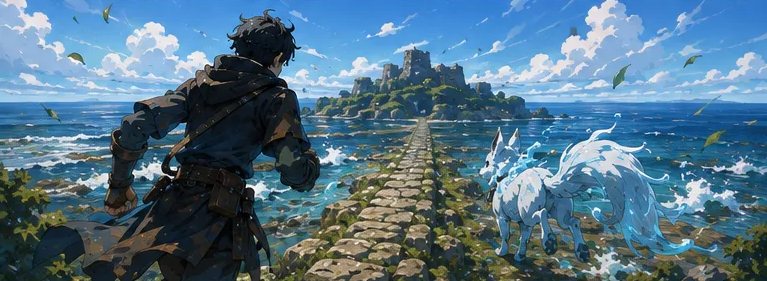
Below, as far as the eye could see, the sea had withdrawn. Not like a low tide: like a tablecloth being pulled away. The floor of the bay gleamed in the morning light, bristling with seaweed and broken hulls, and down its middle, straight as a stroke of ink, a causeway of ancient flagstones ran toward the black islet — the one whose name the old folk never spoke, the one where Aurel's lantern had gone out.
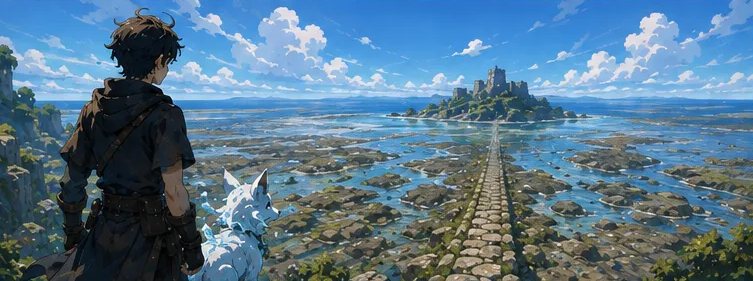
— The tide remembers, said Seafoam softly. And it is waiting for you.